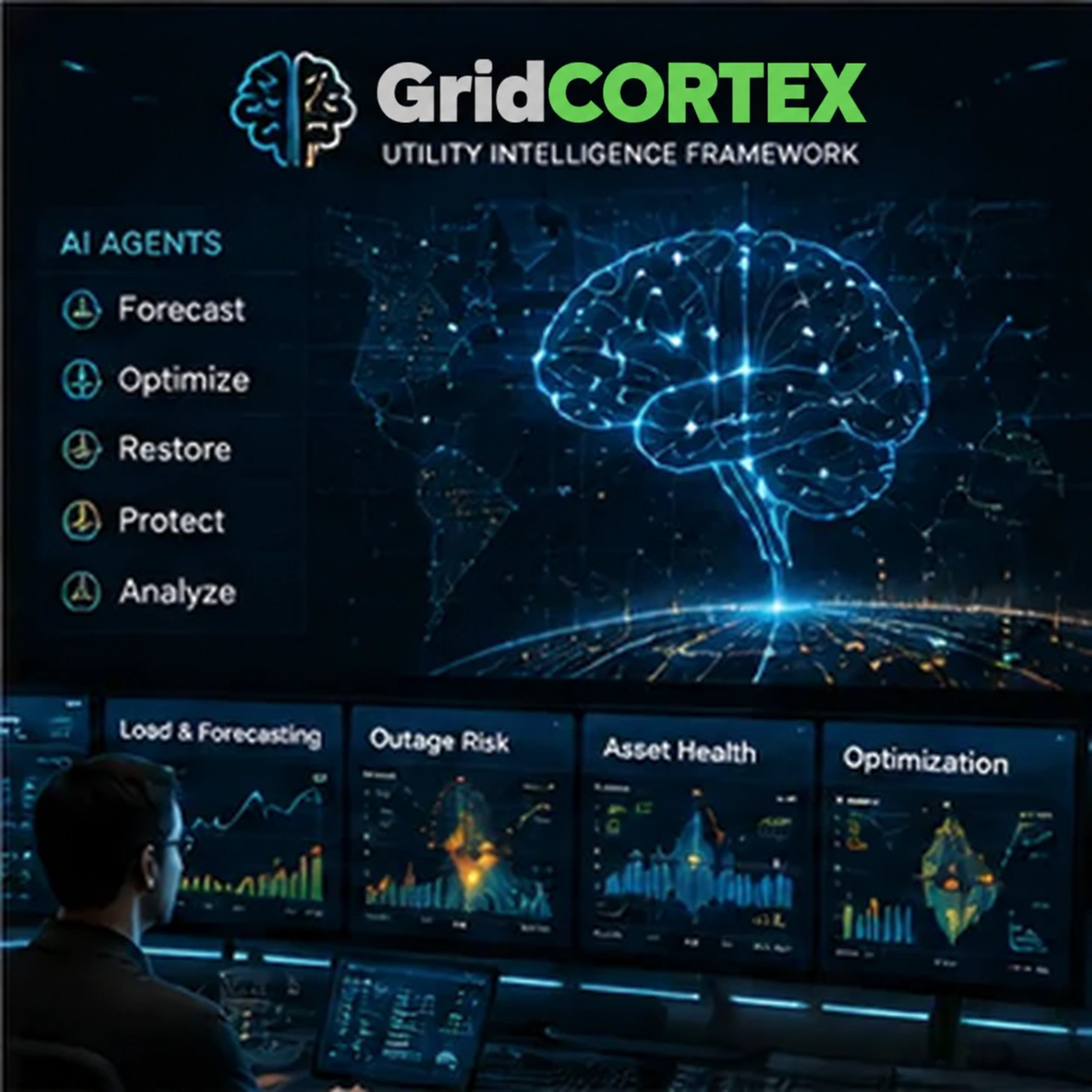

GridCORTEXHomebySoftServe
SoftServe  ·  NVIDIA  ·  Power & Utilities

Utilities don't partner withcompanies that know AI.They partner with AI companiesthat know power grids.

“They don't care that your AI engineers have PhDs and worked at NASA. They want to know if you understand their pain points, and whether you can actually help solve them.”

SoftServeA SoftServe solution

SoftServe's AI-Powered Utility Intelligence Ecosystem

The only credential that matters in a utility sales conversation

GridCORTEX is SoftServe's AI-Powered Utility Intelligence Ecosystem, built by a team with more than 30 years inside utility operations. It sits above the systems a utility already runs, connects what each of them sees on its own, and helps answer the questions none of them were built to answer: where the next storm will do damage, which assets are closest to failure, how quickly a large new load can connect. It starts from the problems utility leaders are funded to solve today, and every decision stays with the engineers and operators who own the grid.

10Agents
24Operating domains
189Catalogued solutions
30+Years of utility operations experience on the team
Built on NVIDIA accelerated computing · Earth-2· Isaac ROS 2· Jetson Orin· Omniverse· NeMo / NIM· Metropolis· cuOpt· RAPIDS· Morpheus· PhysicsNeMo
The Thesis

Grid is the anchor.
CORTEX is the thesis.

In the human body the cortex sits above the nervous system. It thinks, predicts and advises, and it does not replace the reflexes. GridCORTEX thinks above the grid and never overrides the reflexes that keep the lights on.

Your operational technology systems are the grid's reflexes: fast, trusted and untouchable. GridCORTEX sits above them. It helps forecast the storm, rank the failing assets, model data center load and speed up interconnection feasibility, and it explains each answer. It does not touch the controls.
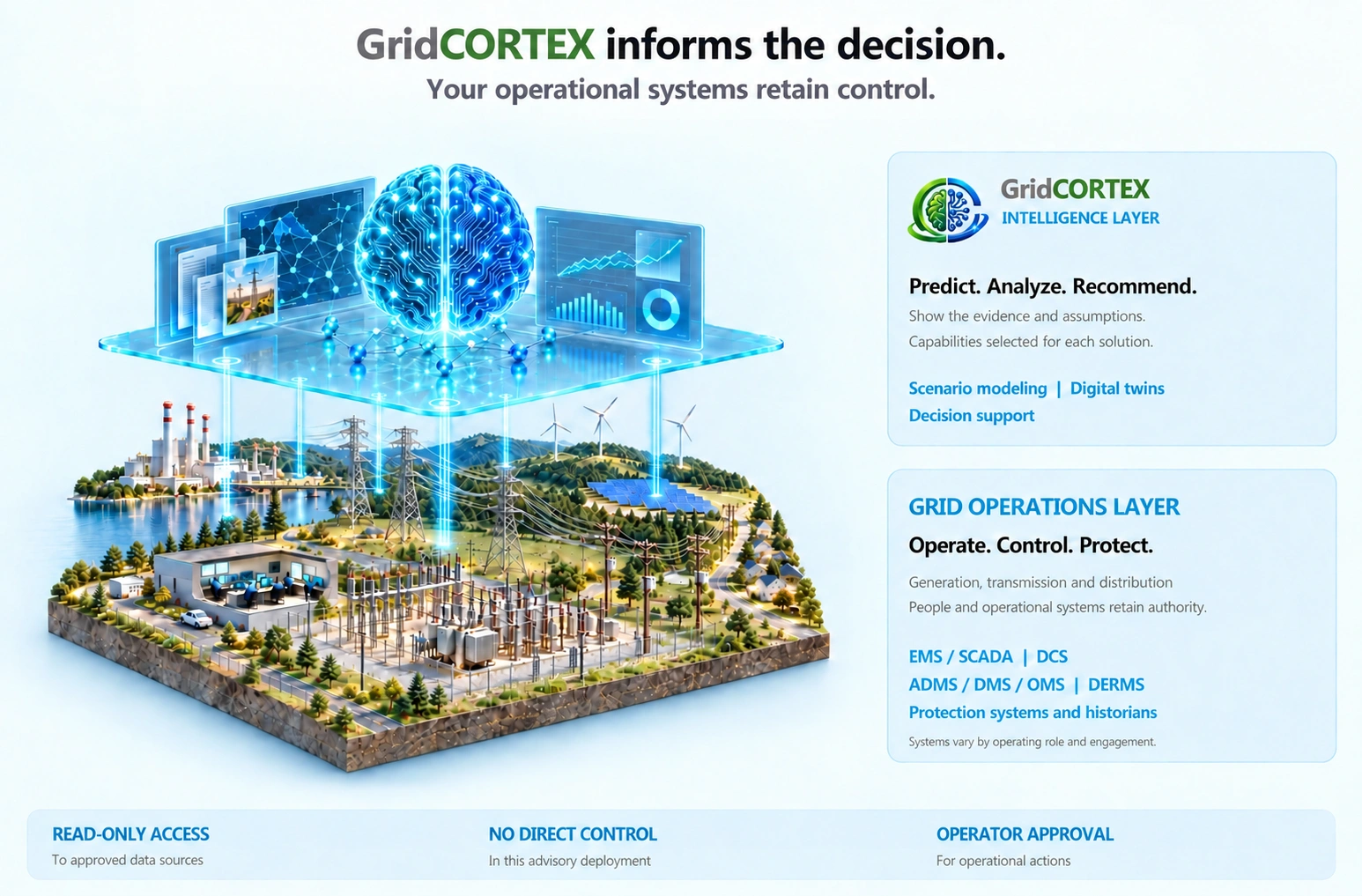
GridCORTEX decision support sits above existing grid operations. The intelligence layer supports scenario modeling, digital twins and evidence-based recommendations. Operational systems retain control, with read-only access to approved data sources and operator approval for operational actions.
WHEN · Why Now Is the Moment

Five forcing functions.
All accelerating simultaneously.

Five industry forces are converging. Utilities that act early will lead. Utilities that wait will spend the next decade catching up.
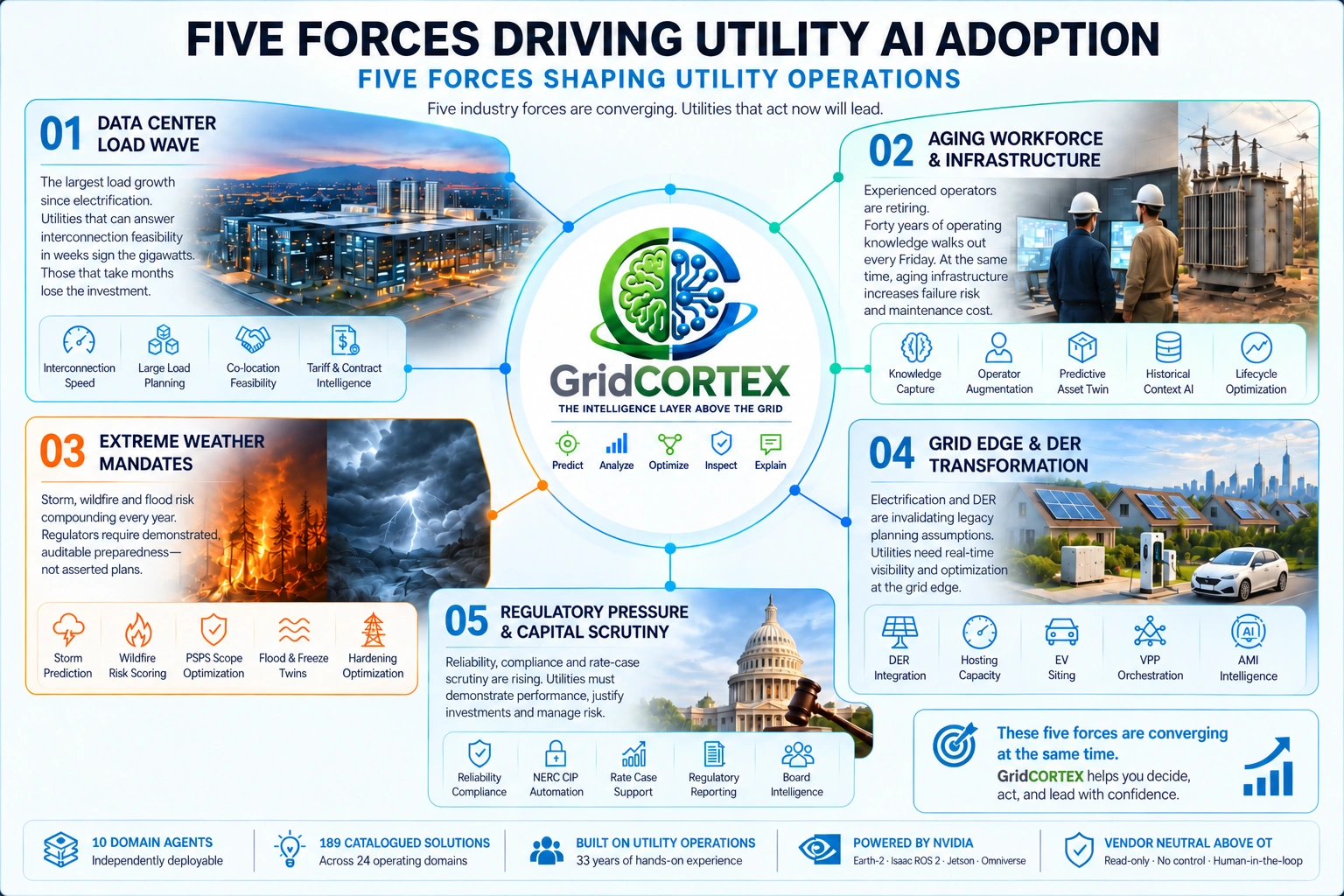
GridCORTEX Five Forces Driving Utility AI Adoption
01
Data Center Load Wave
The largest load growth since electrification. Utilities that can answer interconnection feasibility in weeks win the gigawatts. Those that take months lose the investment.
Interconnection Speed
Large Load Planning
Co-location Feasibility
Tariff and Contract Intelligence
02
Aging Workforce and Infrastructure
A large share of experienced operators retire this decade, and forty years of operating knowledge goes with them. At the same time aging infrastructure raises failure risk and maintenance cost.
Knowledge Capture
Operator Augmentation
Predictive Asset Twin
Historical Context AI
Lifecycle Optimization
03
Extreme Weather Mandates
Storm, wildfire and flood risk compound every year. Regulators expect demonstrated, auditable preparedness, not asserted plans.
Storm Prediction
Wildfire Risk Scoring
PSPS Scope Optimization
Flood and Freeze Twins
Hardening Optimization
04
Grid Edge and DER Transformation
Electrification and distributed energy resources are invalidating legacy planning assumptions. Utilities need real-time visibility and optimization at the grid edge.
DER Integration
Hosting Capacity
EV Siting
VPP Orchestration
AMI Intelligence
05
Regulatory Pressure and Capital Scrutiny
Reliability, compliance and rate case scrutiny keep rising. Utilities must demonstrate performance, justify investments and manage risk.
Reliability Compliance
NERC CIP Automation
Rate Case Support
Regulatory Reporting
Board Intelligence

AI is entering utility operations now. We believe the window to become a utility's named partner on the stack is roughly 12 to 18 months. Each lead domain (Connect, Resilience, Asset and Operations) maps to at least two of these forces by design.

See the ten agents →
HOW · How It Works

Built to work with
what you already have.

GridCORTEX sits above your existing OT infrastructure. No rip-and-replace, no control system changes and no disruption to systems of record.

Analyzes. Does not control.
GridCORTEX reads approved data from your ADMS, OMS, EMS, SCADA and GIS and returns recommendations and draft work that a person reviews. It does not issue switching, protection-setting or dispatch commands and holds no control authority. If an engagement needs a recommendation written back into a business system such as OMS or EAM, that integration is scoped, credentialed and approved on its own, with a named person owning the workflow.
Consulting and Engineering, Delivered
SoftServe delivers GridCORTEX through consulting, engineering, implementation and managed services, not a software subscription. What that actually looks like from the first conversation to production is set out directly below.
Every Answer Explained
Human-in-the-loop governance is part of the architecture. Each recommendation carries its supporting evidence, its assumptions and its known limitations, so your operators can review it, challenge it and overrule it.
MAP · Mind Map

GridCORTEX for utilities

GridCORTEX for utilities: the public mapSix branches from GridCORTEX: our story, utility challenges, agents, how it works, demonstrations and start a conversation, each with the points it covers. GridCORTEX Our story utility experience · intelligence above existing systems ·operational systems retain control Utility challenges large loads · workforce and infrastructure ·extreme weather · grid edge · regulatory pressure Agents Operations · Resilience · Asset · Edge · Customer · Connect ·Enterprise · Nuclear · ISO/RTO Markets · Physical AI How it works predict · analyze · model · recommend · explain ·bounded pilot GridDEMO selected fictional or synthetic scenarios ·illustrative outcomes Start a conversation problem · relevant capabilities · working session
WHERE · Reference Architecture

The Gap Layer

Above OT. Below the enterprise. Between the systems. GridCORTEX connects read-only, returns recommendations for human review, and never holds control authority.
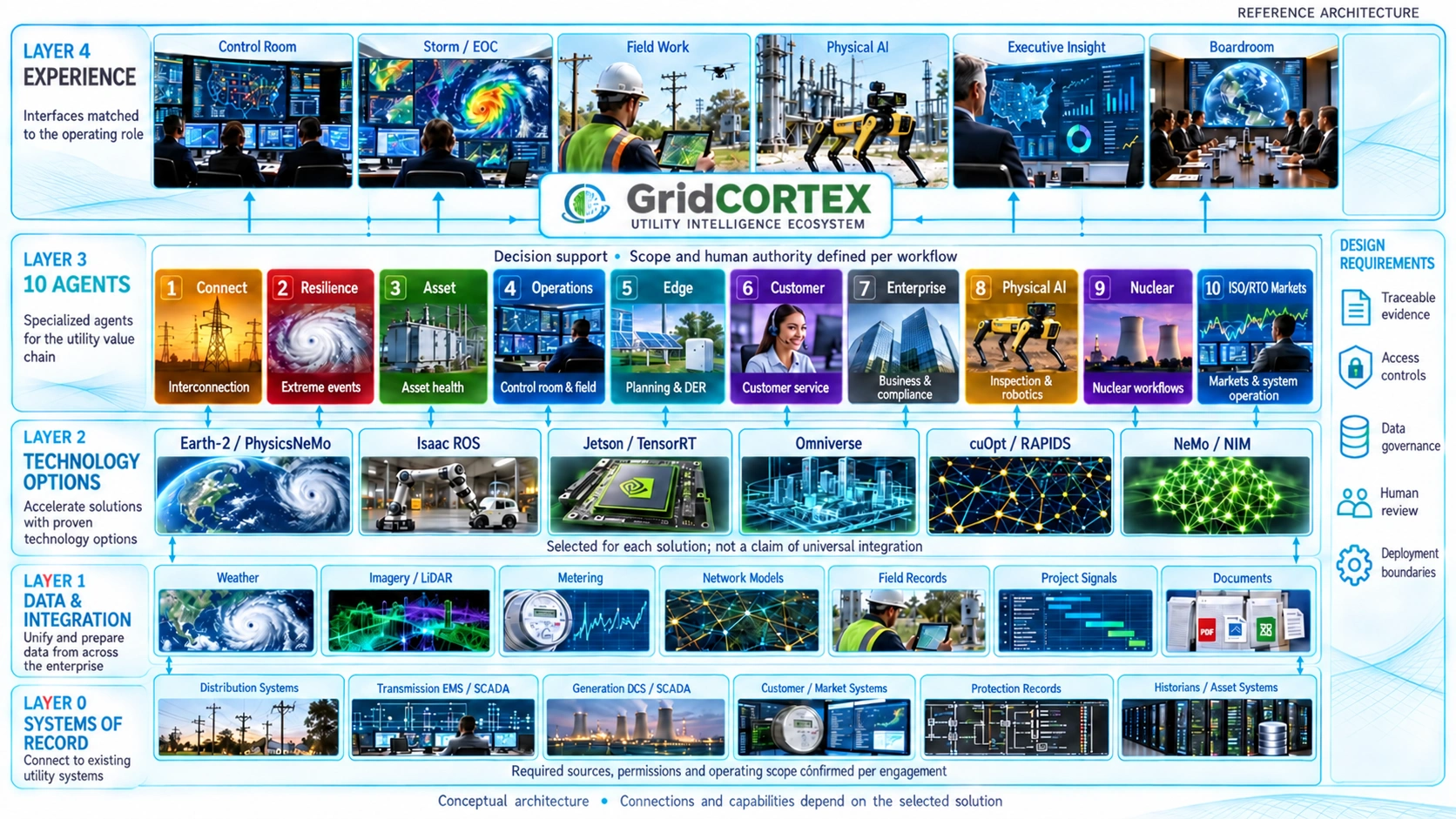
GridCORTEX Architecture, 5 Layer Stack from OT Systems to Experience
Layer 4
Experience
Control room, emergency operations center, field, executive
Layer 3
GridCORTEX
10 agents · 24 domains · 189 catalogued solutions
Layer 2
NVIDIA Engines
Earth-2 · NeMo · cuOpt · Omniverse · Agent Toolkit
Layer 1
Data Fabric
AMI · GIS · EAM · Weather · LiDAR
Layer 0
OT Systems
ADMS · EMS · DERMS · OMS · PI
One Ecosystem, Ten Agents, 24 Domains, 189 Catalogued Solutions

Enter through what
utilities are funding today.

GridCORTEX is ten domain agents in one ecosystem. Each activates on its own above the systems you already run, so you start wherever the budget and the sponsorship already are.

Every domain stands on its own. Start with the one that has an active budget, a named executive sponsor and a business case you can defend, whether that is nuclear, storm resilience, the control room or the interconnection queue.

The ten share one intelligence foundation, so the second domain costs less to add than the first. Each activates independently, with no rip-and-replace and no OT disruption.

WHO · The Team Behind GridCORTEX

Five chairs.
One perspective.

Most grid modernization solutions are built from a single viewpoint: software vendor, consultant or systems integrator. GridCORTEX was built from all five, which is why each solution starts with operations, not technology.

The Operator
01 · Operations
The Operator
We have lived inside the utility control center.
Reliability, outage restoration, storm response, switching operations, NERC compliance and the realities of a live grid.
The Technology Provider
02 · Technology
The Technology Provider
We have built and deployed grid technology.
ADMS, DERMS, OMS, EMS and SCADA, architected, integrated and delivered across North America and internationally.
OT depth from the inside.
The Systems Integrator
03 · Integration
The Systems Integrator
We have led modernization programs across vendors and platforms.
Integration, governance, data management, organizational change, and enterprise transformation at scale.
Complex ecosystems connected.
The Consulting Partner
04 · Strategy
The Consulting Partner
We have advised utility executives on large-scale transformation.
Strategy, business cases, operating models, technology roadmaps, and modernization planning from the executive table.
Executive-level perspective.
The AI Solutions Leader
05 · AI + Grid
The AI Solutions Leader
Today we apply all five perspectives to utility AI.
GridCORTEX combines operational expertise, utility domain knowledge, and NVIDIA accelerated computing, starting with operations, not technology.
Why This Matters
Nothing in the ecosystem was designed from the outside looking in.
Every use case, every buyer brief, every pilot design, built from experience at the actual utility table. That is the credential that matters.
→
Most AI solutions start with technology and search for a problem.
→
GridCORTEX starts with utility operations, every time.
WHY · Four Advantages

How we approach utility problems.

01
Practitioner Depth
GridCORTEX was built from every seat at the utility technology table. Nothing in the ecosystem was designed from the outside looking in.
02
NVIDIA-Native Engineering
Earth-2, Isaac ROS 2, Jetson Orin, Omniverse, NeMo, cuOpt, RAPIDS, Metropolis, Morpheus and PhysicsNeMo. We build on the stack the problems require, because the physics of the grid call for physics-informed compute.
03
Vendor Neutrality Above OT
SoftServe sells no ADMS, no EMS, no meters and no OT hardware. We stay neutral above GE, Schneider, Oracle or any other OT vendor, so a utility on one ADMS and a utility on another get the same honest gap analysis.
04
Start with one specific problem
Bring the problem your team has been asked to solve this year. In a working session we walk through the workflow, who owns it, the data and technology it would need, and a bounded pilot approach, so you can decide whether it fits your utility and what to test next.
How SoftServe Engages

What it looks like
if we start talking.

We begin by choosing the problem and reviewing a reference pilot design for it. The first conversation is about which problem is worth solving first, against a plan already on paper. You should leave with two named use cases and a view of what proving them would involve.

01
Consulting
2 to 6 weeks, indicative
Name the problem, scope the proof
We start from a problem your people already describe the same way, and test the reference pilot design against your environment: which systems it reads, what history exists to prove it, who signs off and what is in the way. You get a scoped engagement, a single KPI agreed in writing and an honest account of what we could not confirm.
What moves it forward: one named problem, one owner, and access to enough history to test it.
02
Engineering
3 to 6 months, indicative
Prove it on your own history
Our engineers build against your data in read-only mode and, where the history supports it, replay your own past events: the storm you worked, the outage you restored, the alarm flood your operators sat through. We compare what the system would have surfaced with what actually happened, on events held back from the build where practical. That is a harder test than a demonstration on sample data. It is not the same as live operational performance, which only running it proves.
What moves it forward: the agreed KPI met on your events, and your operators saying the reasoning holds up.
03
Implementation + Managed Services
Ongoing
Production, then the next one
Production deployment with engineering and managed services behind it, governed the way it was piloted: read-only access to approved sources, evidence and stated limitations behind each recommendation, and an operator approving anything operational. Later use cases can reuse approved integrations where their systems, data and security needs overlap.
What moves it forward: a production result your organization will stand behind, and a second problem worth the same treatment.

Two things we will not do. We will not write to your control systems, in a pilot or in production. And we will not scope a multi-year program from a first conversation; the first engagement is small enough to be judged on its own. The durations above are planning ranges, confirmed once scoping is done.

Explore more with our utility team

These selected demonstrations are a starting point. We have many more capabilities and scenarios to discuss. Contact us to explore the agents, domains and use cases relevant to your utility.

Talk with our utility team

Contact us about the problem your utility needs to solve.
Contact form routing will be connected by SoftServe marketing before publication.

Use SoftServe’s current contact form
Page content updated 10/14/2026, 4:02 PM CDT